

How much should a small business website cost? The answer depends on what you’re building, who’s developing it, and which services are included.
A $199 website special and a $3,000 professional development project may both deliver functioning websites, but their scope, ownership arrangements, and ongoing costs can differ considerably. Understanding domain registration, hosting, development services, promotional pricing, and long-term maintenance will help you identify hidden expenses, avoid vendor lock-in, and make a more informed investment.
Understanding the Basic Costs
Think of a website like a cellphone. Your domain name is similar to your phone number, while hosting is comparable to your cellular service plan. The website itself is like the phone and its applications, the experience customers actually use.
Each serves a different purpose.
Domain registration gives your business the renewable right to use an address such as yourbusiness.com. Domains are generally billed annually, and renewal pricing may differ from introductory offers.
Website hosting provides the server infrastructure that stores and delivers your website to visitors. Hosting may be billed monthly or annually, often with discounts for longer commitments.
Website development covers the work of planning, designing, building, configuring, and launching the website.
These are separate costs, even when a provider bundles them into one advertised package.
Business email, premium software, maintenance, and additional functionality may introduce other expenses.
Choosing a Hosting Provider
Popular hosting providers include Bluehost, GoDaddy, and SiteGround. Each offers different combinations of hosting, domain registration, WordPress tools, security features, and support.
TrajectOS commonly uses Bluehost because its WordPress hosting environment, available security features, and management tools align with our development approach.
However, no provider is automatically the best choice for every business.
Compare hosting plans based on performance requirements, included security protections, backup availability, customer support, renewal pricing, and the ability to migrate your website.
Some security and backup features are included only with certain plans or require additional subscriptions.
Hosting decisions should support the website’s intended functionality and long-term growth. Understanding these considerations is an important part of hiring a website developer who can align technical decisions with your business needs.
What Does a $199 Website Special Actually Include?
Low-cost website promotions can be legitimate, particularly when they involve templates, limited customization, or a small number of pages.
The advertised price, however, may cover only the initial setup.
Before purchasing, determine whether the package includes domain registration, hosting, mobile optimization, SEO configuration, contact forms, security, and post-launch support.
Also investigate the terms behind the offer.
Does the price require a multiyear hosting commitment? Will renewal rates increase? Are essential features billed separately? Can the finished website be transferred to another provider?
A $199 launch offer can become considerably more expensive when required subscriptions, renewals, and additional development are considered.
The concern isn’t necessarily the promotional price. It’s whether the buyer understands the complete financial commitment.
Compare the first-year cost and the projected three-year cost, including any required renewals or subscriptions.
What Are You Actually Paying a Developer For?
Website development involves more than assembling pages.
A professional engagement may include business discovery, brand-aligned design, copywriting, responsive layouts, search-friendly architecture, functional forms, security configuration, and launch testing.
The complexity of those requirements affects the price.
A five-page informational website generally requires less development than a venue website supporting event inquiries, proposals, scheduling, and customer management.
Some businesses need only a reliable digital presence. Others benefit from connecting website inquiries to operational workflows that help employees manage requests through completion.
These capabilities should be evaluated against actual business needs rather than added simply because they’re available. A professional proposal should define deliverables, responsibilities, and exclusions, whether the project involves basic website development or more comprehensive brand and digital services.
Understanding Ownership and Long-Term Costs
The initial development price is only part of a website’s financial picture.
Domain renewals, hosting, maintenance, software subscriptions, backups, and ongoing improvements can contribute to the total cost of ownership.
For budgeting purposes, consider:
First-year investment: Development, setup, domain registration, hosting, and any required initial licenses.
Subsequent annual costs: Domain and hosting renewals, maintenance, recurring licenses, and support services.
Optional enhancements: New functionality, redesigns, additional content, integrations, or ongoing SEO campaigns.
Ownership and portability also affect long-term value.
A business should understand who controls its domain, hosting, website files, and customer data. Data portability means being able to export and transfer business information, such as customer inquiries and submissions, to another provider in a usable format. A low initial price may offer limited savings if changing providers requires rebuilding the website or paying additional fees to retrieve business information.
Before signing, ask for an itemized proposal showing what you’ll pay initially, what renews, and which assets or data can be transferred. This same attention to long-term value applies to other business technology decisions explored throughout our practical business guides.
What Should You Budget for a Small Business Website?
Website pricing varies considerably depending on the level of customization, functionality, and professional services involved. A basic template-based website may be sufficient for a business establishing its first online presence, while a more comprehensive build may include custom design, SEO architecture, business integrations, and ongoing support.
The following estimates provide a practical starting point for budgeting. When comparing proposals, consider both the initial development investment and the recurring expenses required to keep your website operational.
| Website Component | Estimated Cost |
|---|---|
| Domain Registration | $10 – $30 yearly |
| Basic Website Hosting | $50 – $150 yearly |
| Basic Template-Based Website | $200 – $1,000 |
| Professional Website Development | $1,000 – $3,500+ |
| Website Maintenance | $100 – $200 monthly |
Frequently Asked Questions
Do I need to purchase my domain and hosting separately?
Not necessarily. Many providers bundle them, but they remain distinct services with potentially different renewal terms.
Why do website development prices vary so much?
Pricing depends on design complexity, content requirements, functionality, integrations, technical configuration, and the services included before and after launch.
Is a cheap website always a bad investment?
No. A limited website package may be appropriate for a simple business need. The important consideration is understanding its capabilities, exclusions, and ongoing costs.
Should website maintenance be included in the development price?
Maintenance may be included for a defined period or offered separately. Confirm who handles updates, backups, security, and technical support after launch.
Build a Better Business Website
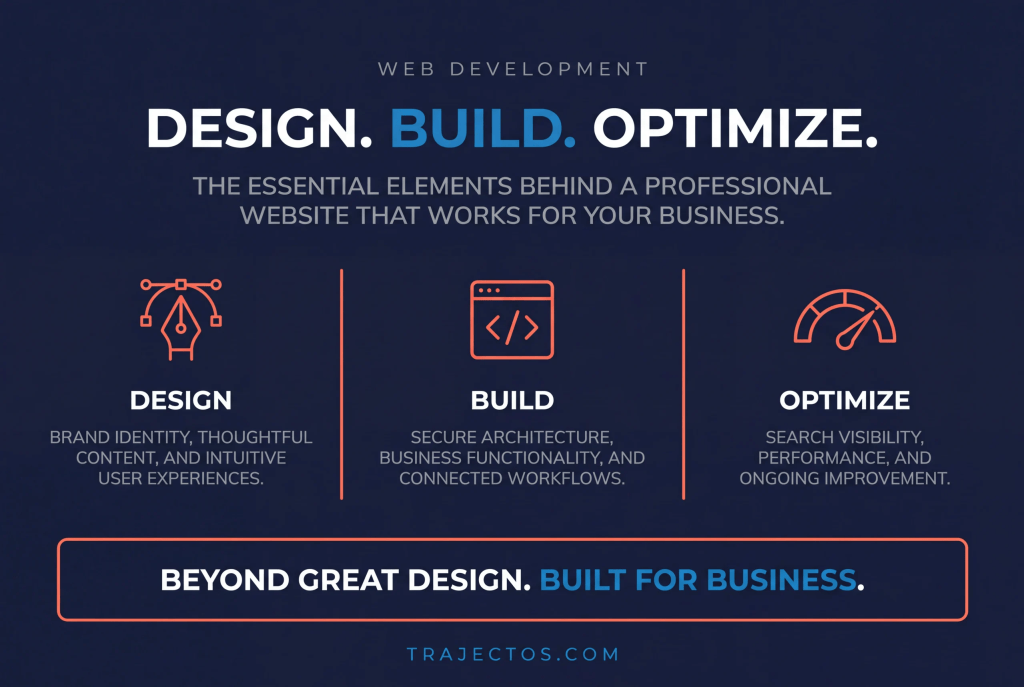
TrajectOS develops professional websites that connect thoughtful design, search visibility, business functionality, and long-term maintainability.
